
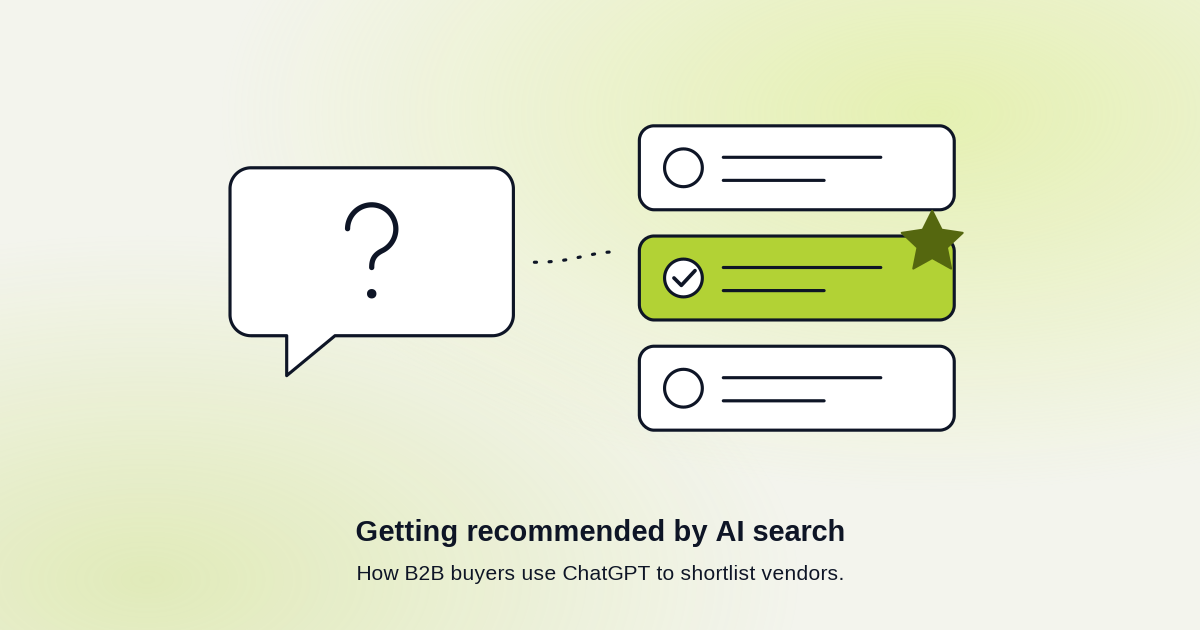
B2B buyers increasingly start vendor research in AI chatbots like ChatGPT. In G2's 2026 survey of 1,076 B2B software buyers, 51% said they now begin their research in an AI chatbot more often than in Google, up from 29% a year earlier. To get recommended, AI tools need to understand clearly what you do, for whom and where, and find that confirmed in specific, verifiable content on your own site and across other trusted sources. This is called generative engine optimisation (GEO), and it builds on SEO rather than replacing it.
For GCC companies, there's an extra layer: buyers ask in Arabic as well as English. If your Arabic presence is thin, an AI tool has little to say about you when a Saudi or Emirati buyer asks in their own language. This guide explains how buyers are using AI, how AI answers are built, and what B2B companies can do to show up.
How buyers are using AI today
- AI is becoming the starting point. In G2's survey, 51% of software buyers start research in an AI chatbot more often than Google, and 71% rely on chatbots for software research. ChatGPT is the most used, at 63%.
- It's used across the whole purchase. Forrester reports that 94% of business buyers used AI somewhere in their buying process.
- It changes shortlists. 69% of buyers in G2's survey said a chatbot surfaced information that led them to choose a different vendor than they expected, and 85% think more highly of a vendor an AI chatbot mentions.
- But buyers still check. Forrester found that 20% of buyers felt less confident after using generative AI because they encountered unreliable or inaccurate information. Clear, verifiable facts about your company protect you from being described wrongly.
These studies are global and focus mostly on software buyers. The direction is the same for B2B services in the Gulf: more of the first impression now happens before a buyer ever visits your website.
How AI answers are built
AI assistants answer from two places: what the model learned during training, and live web results they retrieve when a question needs current information. When they search, they read a handful of pages, summarise them, and often cite them.
That's why SEO still matters, but it isn't enough on its own. Ahrefs' 2026 analysis of 863,000 keywords found that about 38% of pages cited in Google's AI Overviews rank in the top 10 for the same query, and most of the rest rank somewhere in the top 100. Ranking puts you in the pool. Being clear, specific and corroborated gets you chosen.
What gets your company recommended
- Be a clear entity. State plainly what you do, for whom, and where: "a B2B growth partner for companies in Saudi Arabia and the GCC" beats a slogan. Use the same name and description on your website, LinkedIn, Google Business Profile and directories, and add Organization structured data to your site.
- Answer questions directly. Buyers ask AI questions, so write pages that answer them: the question as the heading, a direct answer in the first two or three sentences, then the detail. Add an FAQ section with the real questions your sales team hears.
- Be specific and verifiable. Numbers, named results, dates and real case studies give AI something concrete to repeat, and give buyers something to check. "Moved from #17 to #5 on Google in 12 months" travels further than "proven results".
- Get mentioned elsewhere. AI tools cross-check. Client reviews, partner pages, industry associations, press coverage and event listings all confirm that you are who you say you are.
- Publish in Arabic, not just English. When a buyer asks in Arabic, AI tools look for Arabic sources. Native Arabic pages, not machine translations, make you part of that answer.
- Keep content fresh. Date your articles, update them when things change, and keep facts like services, markets and team current. Stale pages are easier to overlook and more likely to be repeated wrongly.
- Don't block AI crawlers by accident. Check that your robots.txt allows the crawlers of the AI tools your buyers use. Some sites also publish an
llms.txtfile summarising their key pages. It's cheap to add, though there's no public evidence yet that major AI tools rely on it.
How to check your AI visibility
You don't need a tool to start. Once a month:
- Write down 10–15 questions your buyers would ask, such as "best B2B marketing agency in Riyadh" or "how to enter the Saudi market", in English and in Arabic.
- Ask them in ChatGPT, Gemini, Perplexity and Google, using a clean session.
- Record whether you're mentioned, how you're described, which competitors appear and which sources are cited.
- Fix what's wrong or missing: an unclear description, a missing Arabic page, a source that cites outdated information.
The cited sources are the most useful part. They tell you exactly which pages and platforms the AI trusts for your topic.
What this means for GCC B2B companies
- Your website is now read by machines first. A vague homepage costs you twice: with buyers, and with the AI tools summarising you for them.
- Arabic content is a real opening. In our experience, many B2B companies in the region still treat Arabic as a translation step, which leaves room for companies that publish properly in both languages.
- Case studies do double duty. Specific results convince human buyers and give AI concrete facts to cite.
- Consistency builds trust. The same story on your site, LinkedIn, directories and partner pages makes it easy for AI to describe you accurately.
A quick checklist
- One clear sentence on your homepage: what you do, for whom, where.
- Service pages that answer the questions buyers actually ask, in English and Arabic.
- Case studies with specific, real results.
- Organization and FAQ structured data.
- A consistent profile on LinkedIn, Google Business Profile and key directories.
- A monthly AI visibility check, in both languages.
Frequently asked questions
What is generative engine optimisation (GEO)?
GEO is the practice of making your company easy for AI tools like ChatGPT, Gemini, Perplexity and Google's AI Overviews to understand, cite and recommend. It builds on SEO with clearer entity information, answer-first content, verifiable facts and mentions on trusted third-party sources.
Is SEO still worth it if buyers use ChatGPT?
Yes. AI tools often search the web when answering, and pages that rank are more likely to be found. Ahrefs found about 38% of pages cited in Google's AI Overviews rank in the top 10 for the same query, and most of the rest rank in the top 100. SEO gets you into the pool; GEO helps you get chosen.
How do I get ChatGPT to recommend my company?
There's no way to pay for or force a recommendation. Make it easy: describe clearly what you do, for whom and where; publish answer-first pages with specific, verifiable results; and earn mentions on trusted sites such as reviews, partners, associations and press, in English and Arabic.
Does llms.txt help with AI search?
It's an emerging convention for summarising your key pages for AI tools. It's quick to add, but there's no public evidence yet that major AI assistants rely on it, so treat it as a small extra, not a strategy.
How do I measure my visibility in AI search?
Ask the questions your buyers ask in ChatGPT, Gemini, Perplexity and Google every month, in English and Arabic. Track whether you're mentioned, how you're described, which competitors appear and which sources are cited.
Does Arabic content matter for AI search?
Yes. When buyers ask in Arabic, AI tools look for Arabic sources. Native Arabic pages give them something accurate to draw on; without them, you're less likely to appear in Arabic answers.